

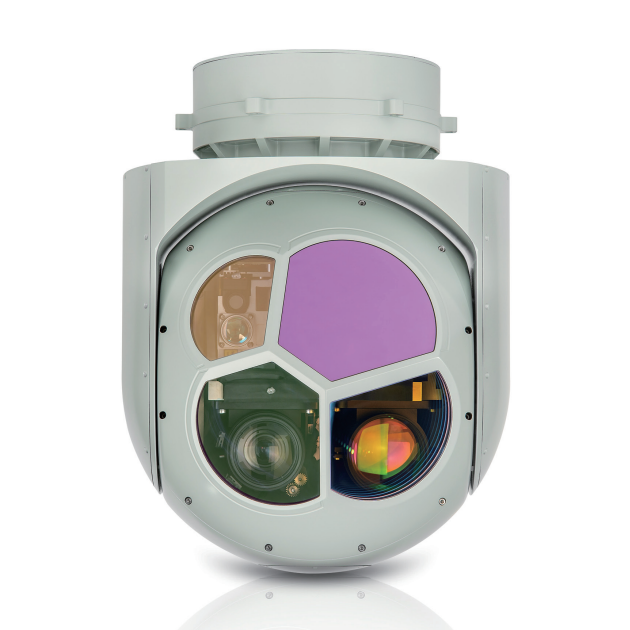
Two Axis Four-sensor Drone Payload-SQG330
Optimized for ISR (Intelligence, Surveillance, and Reconnaissance), this drone payload features advanced AI-powered object recognition and autonomous multi-target tracking. The integrated anti-latency technology ensures a seamless real-time video feed, which is critical for emergency rescue, power line inspection, and law enforcement forensics. Whether navigating complex urban terrain or conducting long-range border patrols, this multi-sensor payload delivers the high-resolution data and thermal accuracy required for mission-critical decision-making.
PRODUCT FEATURES:
1.SQG330 is a two axis four-sensor EO/IR pod,adopting integrated industrial design. It is equipped with a continuous optical zoom TV camera,a long-focus SWIR sensor,a continuous optical zoom cooled MWIR sensor imaging module, and a laser designator.
2.The two axis four-sensor drone payload can be widely adapted to various manned/unmanned helicopters, fixed-wing, and rotary-wing drones, primarily used for imaging, detection, - tracking, identification, localization and guidance of ground targets, meeting the needs of line inspection, accident investigation, emergency rescue, law enforcement and evidence collection, anti-terrorism and riot control, among others.
PRODUCT PARAMETERS:
|
Model |
SQG330 |
|
Product name |
Two Axis Four-sensor Drone Payload |
|
TV |
|
|
Working band |
3.5μm |
|
Exposure method |
Global shutter |
|
Resolution |
1920x1080 |
|
Focal length |
f=10-300mm |
|
Field Of View angle |
37.2°x1.3° |
|
Coaxiality |
≤3pixel |
|
SWIR |
|
|
Working band |
0.9μm-1.7μm |
|
Pixel |
15μm |
|
Exposure method |
Global shutter |
|
Resolution |
640x512 |
|
Exposure method |
TEC Refrigeration |
|
Focal length |
300mm |
|
Horizontal Field of view angle |
1.83°x 1.46° |
|
MWIR |
|
|
Working band |
3μm-5μm |
|
Pixel |
15μm |
|
Cooling time |
≤6min@normal temperature |
|
Resolution |
640x512 |
|
NETD |
25mK@25°C |
|
Focal length |
15-330mm continuous zoom/F4.0 |
|
Horizontal field of View |
35.5°~ 1.67° |
|
Coaxiality |
≤3pixel |
|
LASER DESIGNATOR |
|
|
Wave length |
1064nm |
|
Laser energy |
80mJ |
|
Ranging range |
≥15km |
|
Angular measurement accuracy |
±5m |
|
Range frequency |
Single time, 1Hz, 5Hz |
|
Divergence angle |
≤0.3mrad support custom precise frequency codes |
|
SINGLE OBJECT TRACKING |
|
|
Object type |
Generic objectives |
|
Tracking rate |
≥32pixel/frame |
|
Updated frame rate |
≥50FPS |
|
MULTIPLE OBJECTS TRACKING |
|
|
Object type |
Human, Vehicle, Ships, Airplane |
|
Recall |
≥90% |
|
Accuracy |
≥80% |
|
Minimum object size |
32x32@1080P |
|
Tracking object quantity |
≥20 |
|
Tracking transition rate |
≤15% |
|
Update frame rate |
≥25FPS |
|
Weight |
≤22kg |
FAQ:
1. Q: How does AI object recognition improve surveillance missions?
A: AI integration automates the identification process, reducing the cognitive load on the operator. Instead of manually scanning a screen, the system can automatically flag specific targets—such as vehicles, humans, or heat anomalies—and lock onto them instantly, ensuring that critical targets are never lost during high-stress operations.
2. Q: What are the primary advantages of integrating four sensors into a 2-axis gimbal system?
A: The primary advantage is enhanced situational awareness without significantly increasing the weight or aerodynamic drag of the drone. By utilizing a 2-axis configuration (typically pitch and yaw), the system remains lightweight and compact, which is ideal for long-endurance missions. The four-sensor array—which commonly includes a high-resolution daylight camera, an infrared (IR) thermal imager, a laser rangefinder, and a low-light sensor—allows the operator to gather multifaceted data (visual, thermal, and spatial) simultaneously. This makes it a highly efficient solution for search and rescue, perimeter monitoring, and agricultural scouting.