
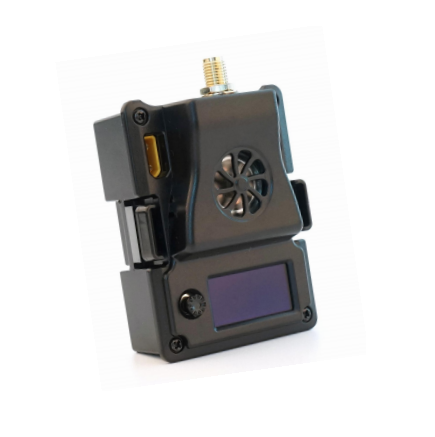
High Frequency Head for Drones-SHF433
PRODUCT FEATURES:
1. Stable and Reliable: Utilizes a Semtech SX1276 RF chip, offering strong anti-interference capabilities and ensuring clear and stable signal even at long distances and in complex environments.
2. Rapid Response: Equipped with dual MCUs (ESP32 + ESP8285), providing low command transmission latency and a smooth control experience.
3. Flexible Adaptability: Supports customizable frequency bands from 360 to 560MHz to meet diverse flight scenarios and application needs.
4. Convenient and Easy to Use: Type-C data transmission interface, TX30 power supply, compatible with JR bay remote controllers, simplifying installation and expansion.
5.Adjustable Power: Freely switchable output from 100 to 1000mW, balancing short-range energy saving with long-range stability.
PRODUCT PARAMETERS:
|
Model |
SHF433 |
|
Product name |
High Frequency Head for Drones |
|
Frequency band |
433MHz;360-560MHz |
|
Output power |
100mW/250mW/500mW/1000mW |
|
Refresh rate |
25Hz/50Hz/100Hz/200Hz |
|
Input voltage |
5-8.4V(2S) |
|
Main control IC |
ESP32+SX1278, Backpack chip ESP8285 |
FAQ:
1.Q: What is high frequency head for the drone?
A: A high-frequency head for drones is a device that improves signal stability and range for remote control, and is often an external module that connects to the remote control’s radio transmitter.
2.Q: What are the main parts of FPV drone system?
A: Here are the main parts of FPV drone systems as below:
①The chassis: the chassis is the structure of the drone. Its purpose is to hold together the different parts that make it up. Its main function is to show durability and resistance to possible knocks and damage that the UAV may suffer.
②FPV system: FPV system is the main distinguishing feature of this type of drone. Consisting of a camera and a transistor, it is responsible for sending the signal and the resulting image to the person who is driving the drone on the ground.
③FPV goggles: these are another main elements of this kind of drone. Thanks to the signal emitted by both the transmitter and the drone’s camera, the goggles show the operator the corresponding image. Depending on its quality, the image will be better or worse.
④Remote control: remote control refers to the controls by which the operator on the ground operates the FPV drone. Generally, it consists of two levers from which the height and speed at which the UAV files is calculated. Its sensitively will depend on the FPV drone in question, but normally it has to be handled with care in order to ensure that the movement of the device is dynamic and fluid.